
We may earn money or products from the companies mentioned in this post.
Start with a food that is complete and balanced for your dog’s life stage. Then compare the calories, cost to feed, and preparation you can manage day to day. If your dog is healthy and doing well on an appropriate diet, you may have little reason to switch. AAHA feeding guidelines.
Read the nutritional adequacy statement first
Look for the nutritional adequacy statement on the package. In the U.S., a dog food labeled complete and balanced is intended to supply the nutrients a dog needs as a sole diet for the life stage listed. The statement can indicate that the recipe meets an AAFCO nutrient profile or that feeding trials substantiated its adequacy. Check for adult maintenance or growth, as appropriate. For a puppy expected to become a large dog, read the growth statement for any size limitation. Treats and foods labeled for intermittent or supplemental feeding have a different role. FDA guide to complete and balanced pet food. AAFCO guide to reading labels.
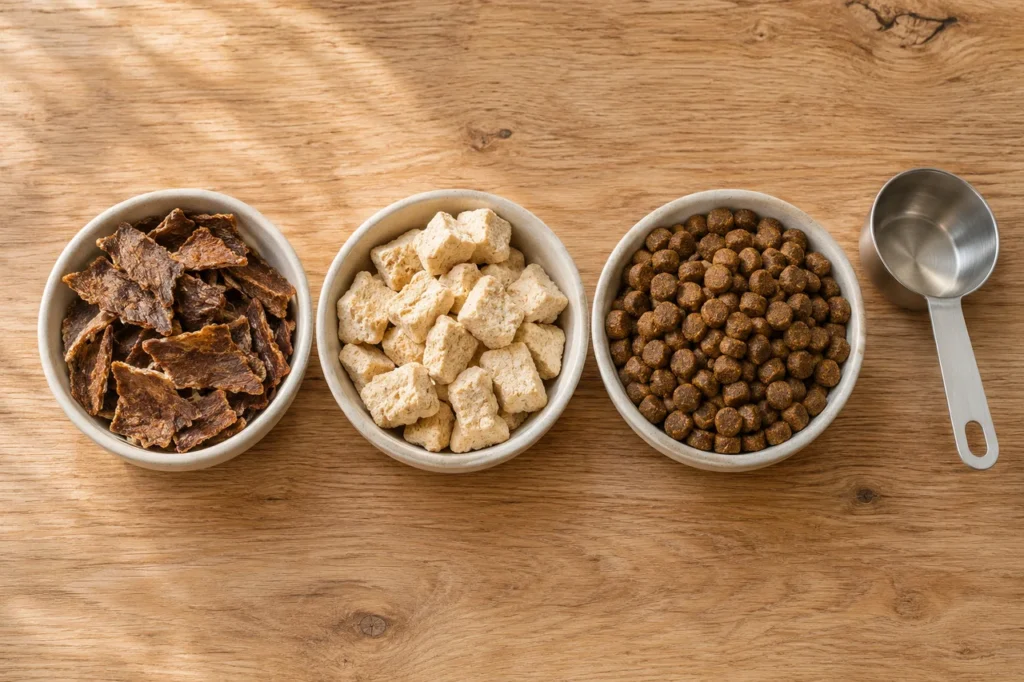
Compare kibble, air-dried, and freeze-dried food
Once you’ve narrowed your options by life stage, compare what each recipe requires at mealtime. Read the feeding, preparation, and storage directions for the exact product.
| Format | What to compare |
|---|---|
| Kibble | Dry pellets. Compare calories per serving, bag size, and cost for the amount you would feed. |
| Air-dried | Food dried using airflow. Check serving weight, calories, and how long the manufacturer says to use the bag after opening. |
| Freeze-dried | Food frozen and dried under vacuum. Check whether the maker calls for rehydration and whether the product is sold as a full meal, topper, or treat. |
For any product labeled raw, check the handling instructions and consider the risks to your household. The CDC advises against feeding raw pet food or treats because they can carry harmful germs, including when the raw ingredients have been freeze-dried or dehydrated. CDC pet food safety guidance. How dry kibble is made.
A smaller bag can cost more to feed if it contains fewer calories. To compare two packages, multiply each bag’s net weight in kilograms by its listed kcal/kg. Then divide the price by that total and multiply by 100 for the cost per 100 kcal. For example, a $24 bag with 4,000 kcal costs $0.60 per 100 kcal. Use the portion your dog actually needs when budgeting. See more examples of air-dried feeding costs.
Look for useful sourcing and packaging details
The ingredient list is ordered by weight. Use it to identify ingredients you’re looking for and read the adequacy statement to assess whether the recipe can serve as a complete diet. Names on the front of the bag have their own rules. AAFCO ingredient-label guidance. How dog food recipe names work.
If sourcing matters to you, ask the company who makes the food, who formulates it, and how the company checks ingredients and tests the finished product. For a recycling or composting claim, check what it covers on that specific bag and whether your local program accepts it. Keep the food in its original bag so the product name, lot code, and best-by date stay handy. You can put the whole bag inside a clean, dry container. WSAVA questions to ask pet food companies. FDA advice on storing pet food.
Make a gradual transition
For an otherwise healthy dog, AAHA says a diet change over four to seven days may help reduce digestive upset. Start by mixing a small amount of the new food with the current food. Gradually increase the new portion as your dog tolerates it. Check the calorie amounts on both labels as you adjust portions. Equal scoops can deliver different amounts of energy. AAHA guidance on feeding plans and transitions.
If your dog has recurring digestive symptoms, a suspected food allergy, or a prescribed diet, discuss the change with your veterinarian first. A diet trial for a suspected allergy requires a specific plan. AAHA guidance on veterinary diet trials.
Before you buy
Check the life stage, calories, preparation directions, and whether the food fits your budget at your dog’s usual portion. Keep the label handy during the switch so you can track what you fed if questions come up.