

We may earn money or products from the companies mentioned in this post.
ZIWI Peak Original Air-Dried Beef Recipe for Dogs offers a convenient way to feed a concentrated, beef-based food without cooking or thawing. This ZIWI Peak air dried beef review examines the published ingredients, nutrition information, feeding considerations, and value using a research-based editorial approach.
Quick Verdict
Consider it if convenience and compact portions justify the cost for your household. Its appeal is straightforward: a ready-to-serve format and several ways to use it, from a complete meal for eligible dogs to a measured topper.
The main tradeoffs are expense, careful portion measurement, and suitability for your individual dog. Beef is not appropriate for every dog, and the recipe also contains mussel. The current manufacturer information excludes its use as the sole growth diet for puppies expected to reach at least 70 pounds as adults.
This assessment is based on published information, not a feeding trial, palatability test, or independent laboratory analysis. Premium pricing and an appealing ingredient list do not establish better health outcomes.
What Is Air-Dried Dog Food?
ZIWI describes its process as circulating warm air around raw ingredients to remove moisture. It markets the finished product as a convenient alternative to raw feeding. That description should not be read as proof of sterility or as a reason to skip normal food hygiene.
Air-drying is a form of dehydration. Products marketed as “dehydrated” vary in their processing and preparation instructions; there is no sound basis for assuming that all use higher temperatures than air-dried foods. Freeze-drying is a different process that removes moisture from frozen material. Check each product’s directions rather than assuming that every dried food needs water added.
For shopping purposes, the useful questions are practical: Does the food suit the dog’s life stage? How many calories does it provide? What preparation and storage does the package require?
Ingredients: What the Recipe Contains
The published ingredient list begins with beef, beef tripe, beef heart, beef lung, beef liver, beef kidney, and beef bone. New Zealand green mussel, beef cartilage, and beef spleen follow. Other listed ingredients include lecithin, parsley, dried apple pomace, chicory-root inulin, kelp, added minerals, vitamins, salt, and preservatives.
The named ingredients make the recipe’s components relatively easy to identify. However, organ meat is not automatically superior to other properly formulated animal ingredients, and terms such as “whole prey” are not independent nutritional certifications.
Added vitamins and minerals are part of the formulation. Their presence is not a flaw, and the ingredient list alone cannot show whether one food is better than another. WSAVA recommends looking beyond ingredient-list appeal when selecting pet food.
Beef-Focused Does Not Mean Hypoallergenic
Although ZIWI markets the recipe as single protein, readers should notice the mussel ingredient as well as the beef ingredients. It should not be presented as an animal-ingredient exclusion diet.
If your dog has a known reaction to a listed ingredient, choose another option with your veterinarian. For suspected food allergy, do not use an ordinary retail food change as a substitute for a diagnostic elimination trial. AAHA guidance favors veterinarian-selected prescription diets for true commercial elimination trials because undeclared proteins can undermine the results of trials using over-the-counter foods.
Nutrition and Calorie Density
The manufacturer published the following nutrition figures when checked on October 30, 2026:
| Published measure | Amount |
|---|---|
| Crude protein, minimum | 38% |
| Crude fat, minimum | 30% |
| Crude fiber, maximum | 3% |
| Moisture, maximum | 14% |
| Ash, maximum | 12% |
| Taurine, minimum | 0.05% |
| Chondroitin sulfate, minimum | 1,300 mg/kg |
| Glucosamine, minimum | 1,000 mg/kg |
| Calculated metabolizable energy | 4,900 kcal/kg; 465 kcal per level cup |
Minimums and maximums are label guarantees, not exact measured amounts in every serving. The listed glucosamine and chondroitin figures do not demonstrate that this food treats joint disease.
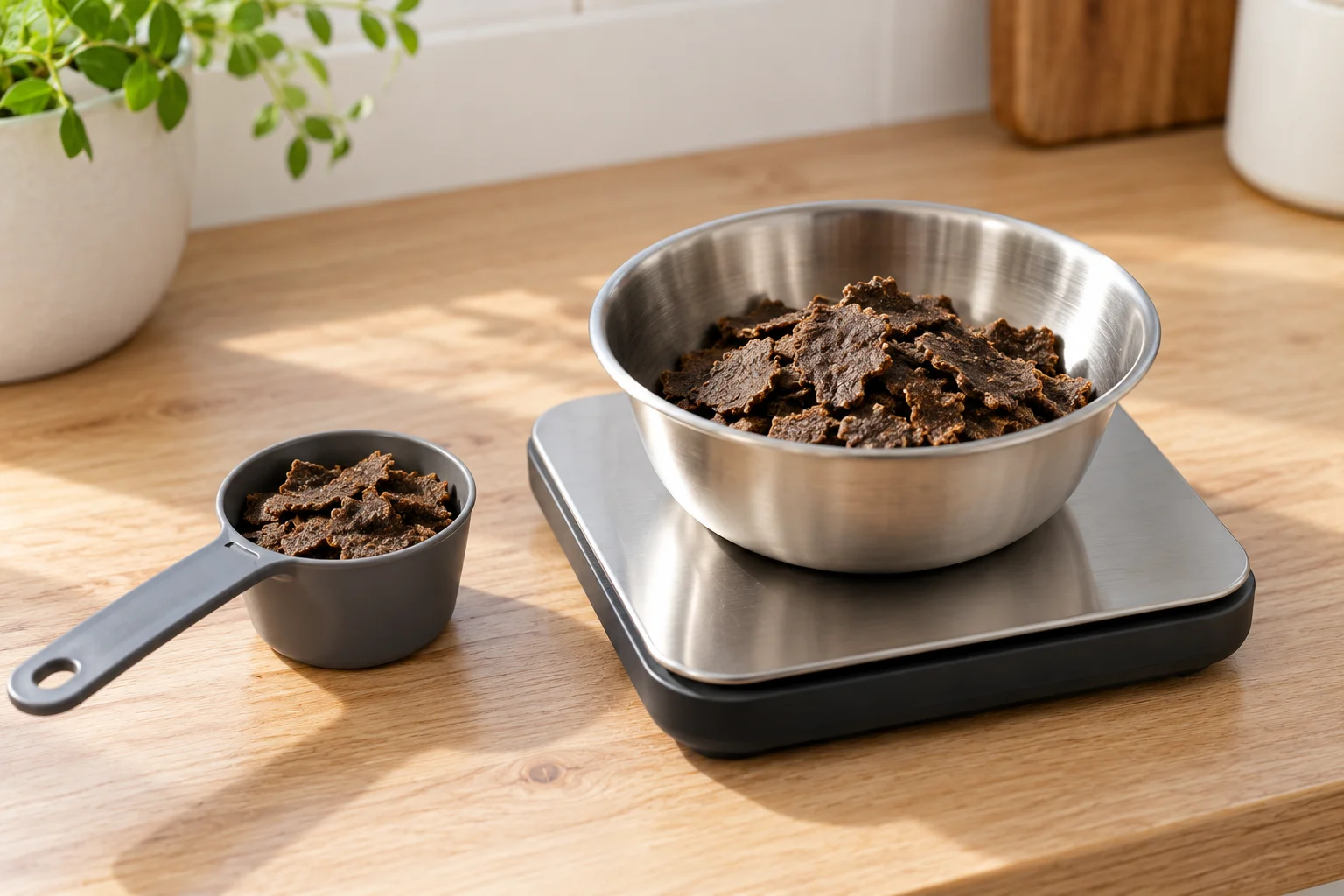
Calories matter when switching foods: a scoop of one product cannot be assumed equivalent to the same scoop of another. Use the current package and feeding calculator as starting points, then monitor body condition and weight. A gram scale makes portion comparisons easier.
An active lifestyle alone does not establish whether this fat level suits a particular dog. A dog with a prescribed dietary fat restriction or another medical nutrition requirement needs an individual feeding recommendation.
Nutritional Adequacy and the Puppy Exception
ZIWI’s current US product page states that the Beef recipe meets AAFCO nutrient profiles for all life stages except growth of large-size dogs expected to weigh 70 pounds or more as adults. The company’s separate puppy-suitability guidance confirms that restriction.
It can therefore be considered as a complete meal for dogs within the stated life-stage coverage, provided it fits their individual needs. It should not be selected as the sole growth food for an excluded large-breed puppy. Check the statement on the actual bag when buying, since formulations and labeling can change. Meeting a nutrient profile is not the same as an AAFCO endorsement or proof of a feeding trial.
Feeding, Transition, and Storage
Use the current package directions or ZIWI’s feeding calculator rather than treating a weight-only serving table as a prescription. Age, activity, body condition, and other food all affect the appropriate daily amount.
When adding this food as a topper, account for its calories and reduce the existing food accordingly. Replacing a quarter of a bowl by volume does not necessarily replace a quarter of its calories. A measured topper also does not guarantee improved nutrition when the base diet already meets the dog’s needs.
ZIWI recommends a gradual transition over at least seven days. Introduce the new food while reducing the old food. Seek veterinary guidance if digestive symptoms persist or are significant rather than assuming they are simply a normal transition.
The manufacturer’s storage advice is to retain the sealed original bag, observe the best-before date, and generally use the food within eight weeks after opening. If using a protective outer container, keep the original bag inside it. Discard food that shows spoilage, including mold.
Follow FDA handling advice: wash hands and food-contact equipment and keep feeding areas clean. If adding water, treat the moistened portion as perishable and follow appropriate leftover-storage instructions.

Price and Value: Calculate Cost per Calorie
Compare the exact bag size, one-time purchase price, subscription terms, shipping, and taxes before deciding what the food will cost. Prices vary, so use a current quote from your chosen retailer.
The following is a hypothetical example assuming a $60 price for a 35.2-ounce bag, not a current retailer quote or a feeding recommendation:
| Calculation | Illustrative result |
|---|---|
| Bag weight | 35.2 oz, approximately 0.998 kg |
| Total energy at 4,900 kcal/kg | Approximately 4,890 kcal |
| Cost per 100 kcal | Approximately $1.23 |
| Cost for 300 kcal from this food | Approximately $3.68 |
| Cost for 600 kcal from this food | Approximately $7.36 |
| Cost for 1,000 kcal from this food | Approximately $12.27 |
The formula is: bag price ÷ total calories in the bag × calories fed per day. Recalculate with the actual price and amount your dog eats. The example calorie amounts are arithmetic scenarios, not daily targets for particular dog weights.
This approach makes it easier to compare different bag sizes and foods. Cost per ounce alone can be misleading when products have different energy densities. A large upfront purchase is worthwhile only if it offers a useful saving and the food can be used within its storage guidance.
Pros and Cons
Advantages
- Convenient format for owners who want to avoid cooking or thawing meals.
- Clearly named ingredients and published nutrition figures.
- Flexible use as a complete meal for eligible dogs, a topper, or treats.
- Compact portions may suit households with limited food-storage space.
Limitations
- Full-meal feeding may be difficult to justify on a tight budget, especially as calorie requirements rise.
- Portion measurement deserves attention when switching from a different food.
- Beef and mussel limit its suitability for dogs avoiding those ingredients.
- The current growth-diet restriction excludes certain large-breed puppies.
- Brand positioning and ingredient descriptions do not prove superior health outcomes.
Who Should Consider Another Option?
Look elsewhere if your priority is the lowest practical feeding cost, if a listed ingredient is unsuitable, or if you need a sole growth diet for a puppy covered by the exclusion.
For a dog with kidney disease, urinary problems, gastrointestinal disease, suspected allergies, or another medical condition, ask the treating veterinarian whether a diet change is appropriate. A therapeutic diet may be recommended for a particular diagnosis; it is not correct to assume the same recommendation applies to every dog with one of these conditions.
For broader context, read our guide to pet food choices and pet nutrition guide.
Frequently Asked Questions
Can it be the only food?
Potentially, for a dog covered by the package’s nutritional adequacy statement whose individual dietary needs it meets. Confirm the current statement and the large-breed puppy exception.
Is it suitable for an allergy elimination trial?
Do not choose it for a diagnostic trial simply because it is marketed as single protein. Ask your veterinarian to select and supervise the appropriate trial diet.
Is air-dried food sterile?
Do not assume so. Dryness, shelf stability, and raw-alternative marketing are not substitutes for food-handling precautions.
Is it worth the price?
That depends on your actual feeding cost and how much you value convenience. It is reasonable to compare it as both a complete-meal option and a measured topper, without assuming either use improves health.
Final Assessment
ZIWI Peak Air-Dried Beef is worth evaluating if its format fits your routine and its feeding cost fits your budget. The decision should rest on life-stage suitability, individual tolerance, accurate portions, and current pricing rather than claims of premium ingredients alone.
Before buying, check the bag’s adequacy statement and ingredients, calculate the cost at your intended feeding amount, and choose a package size that fits your expected use.
Sources
Manufacturer information was checked October 30, 2026. Product descriptions are manufacturer claims unless otherwise stated.
- ZIWI US: Original Air-Dried Beef product information
- ZIWI: Puppy and senior suitability
- ZIWI: Air-drying process
- ZIWI: Transition guidance
- WSAVA: Global nutrition guidelines and food-selection resources
- AAHA: Allergic skin disease guidelines, including diagnostic diet trials
- FDA: Safe handling of pet food and treats