

We may earn money or products from the companies mentioned in this post.
ZIWI Peak Mackerel & Lamb combines fish, lamb, and mussels in a ready-to-serve air-dried food, but its feeding cost can be substantial. This review examines the current US Original Air-Dried recipe, its nutritional adequacy statement, and the calculations that matter when choosing a complete meal or topper.
Quick Verdict
ZIWI Peak Mackerel & Lamb is worth considering when a fish-and-lamb recipe, shelf-stable format, and small serving volume fit your dog’s needs and your budget. Its main limitations are cost, the need to measure portions, and a multiple-animal-source formula that should not be assumed suitable for an allergy investigation or medical diet.
The manufacturer lists 4,500 kcal/kg, equivalent to 4.5 kcal per gram, and 427 kcal per level cup. At the October 30, 2026 prices checked below, a hypothetical 500-calorie allocation costs approximately $6.68 from the 2.2-pound bag or $5.57 from the 8.8-pound bag.
Those are budgeting examples, not feeding prescriptions. This is a source-based editorial review, not a hands-on feeding trial or a verified survey of owner experiences.
What Is Actually in the Recipe?
The official US ingredient list begins with mackerel, lamb, and several lamb organs. It also includes New Zealand green mussel, lamb bone and cartilage, lecithin, parsley, apple pomace, chicory-derived inulin, kelp, added minerals and vitamins, salt, and preservatives.
Lamb liver, lung, heart, and other lamb organs are different tissues from the same animal species. They should not be counted as separate animal species. The relevant distinction is that this recipe contains fish, lamb, and mussel, rather than a single animal source.
The current list does not include grains, potatoes, or legumes. That absence may fit an ingredient preference, but it does not establish a health advantage over every suitable food containing those ingredients.
ZIWI lists glucosamine and chondroitin guarantees, but their presence does not demonstrate that this food will treat a joint condition. Similarly, fish and other animal ingredients do not guarantee improvements in skin, coat, digestion, or any other outcome.
Source: ZIWI’s official Original Air-Dried Mackerel & Lamb page. Check the current package before buying, particularly if an ingredient must be avoided.
Is It a Limited-Ingredient or Allergy Diet?
This review does not establish the recipe as a diagnostic elimination diet or a hypoallergenic food. If your dog needs to avoid fish, the presence of mackerel is directly relevant. A shorter or more expensive ingredient list cannot determine allergy suitability by itself.
Discuss suspected food allergy and any controlled diet trial with your veterinarian. Do not select this formula for that purpose simply because mackerel or lamb is unfamiliar to your dog. Treats and other foods also need to fit any prescribed trial.
Nutrition and Calorie Density
The current manufacturer page provides the following guaranteed analysis. Minimums and maximums are limits, not exact measured amounts for every batch.
| Nutrient | Published guarantee, as fed |
|---|---|
| Crude protein | At least 44% |
| Crude fat | At least 24% |
| Crude fiber | No more than 3% |
| Moisture | No more than 14% |
| Ash | No more than 12% |
| Taurine | At least 0.26% |
| Chondroitin sulfate | At least 1,300 mg/kg |
| Glucosamine | At least 1,000 mg/kg |
The energy statement is 4,500 kcal/kg or 427 kcal per level cup. Use the calorie statement, rather than the size of the pile in the bowl, to convert an allocated number of calories into a serving.
These percentages are as fed. Comparing them directly with a wetter food’s percentages can mislead because the water content differs. This review does not present dry-matter calculations based on guaranteed limits as though they were an exact laboratory analysis.
The 24% fat minimum is lower than the 30% minimum listed for ZIWI Lamb and Beef. That does not prove a particular batch contains less fat than every batch of those foods, and it does not establish suitability for a therapeutic low-fat feeding plan. If food choice is affected by a medical condition or prescribed diet, ask your veterinarian to assess the full nutrient profile.
Can Puppies Eat Mackerel & Lamb?
The current US adequacy statement says the recipe is formulated to meet AAFCO Dog Food Nutrient Profiles for all life stages, including growth of large-size dogs expected to weigh 70 pounds or more as adults.
That is different from the current Beef recipe, whose statement excludes large-size growth. The Mackerel & Lamb statement should not be left vague merely because other ZIWI recipes differ.
Confirm the exact statement on the bag you buy and the feeding plan for your puppy. A statement of formulation to nutrient profiles is not an AAFCO endorsement, proof of a feeding trial, or a finding that this is the best diet for every dog.
Complete Meal Versus Measured Topper
ZIWI describes this recipe as a complete meal, topper, or treat. It is a complete food for the stated life stages, rather than a nutrient supplement that necessarily needs another food to balance it.
For complete-meal use, begin with the current package directions or manufacturer’s feeding calculator and account for other foods and treats. Individual energy needs vary, so the examples below should not replace a feeding assessment.
For topper use, count the calories added and reduce the existing food accordingly. Replacing part of a bowl by volume does not necessarily replace the same proportion of calories. Adding this complete food also does not establish a nutritional benefit when a suitable base diet already meets the dog’s needs.
Grams of Mackerel & Lamb = calories allocated to this food ÷ 4.5.
For example, 100 calories is approximately 22.2 grams. If that were part of a hypothetical 1,000-calorie daily plan, it would represent 10% of those calories. This illustrates the arithmetic; it does not recommend a universal topper percentage.
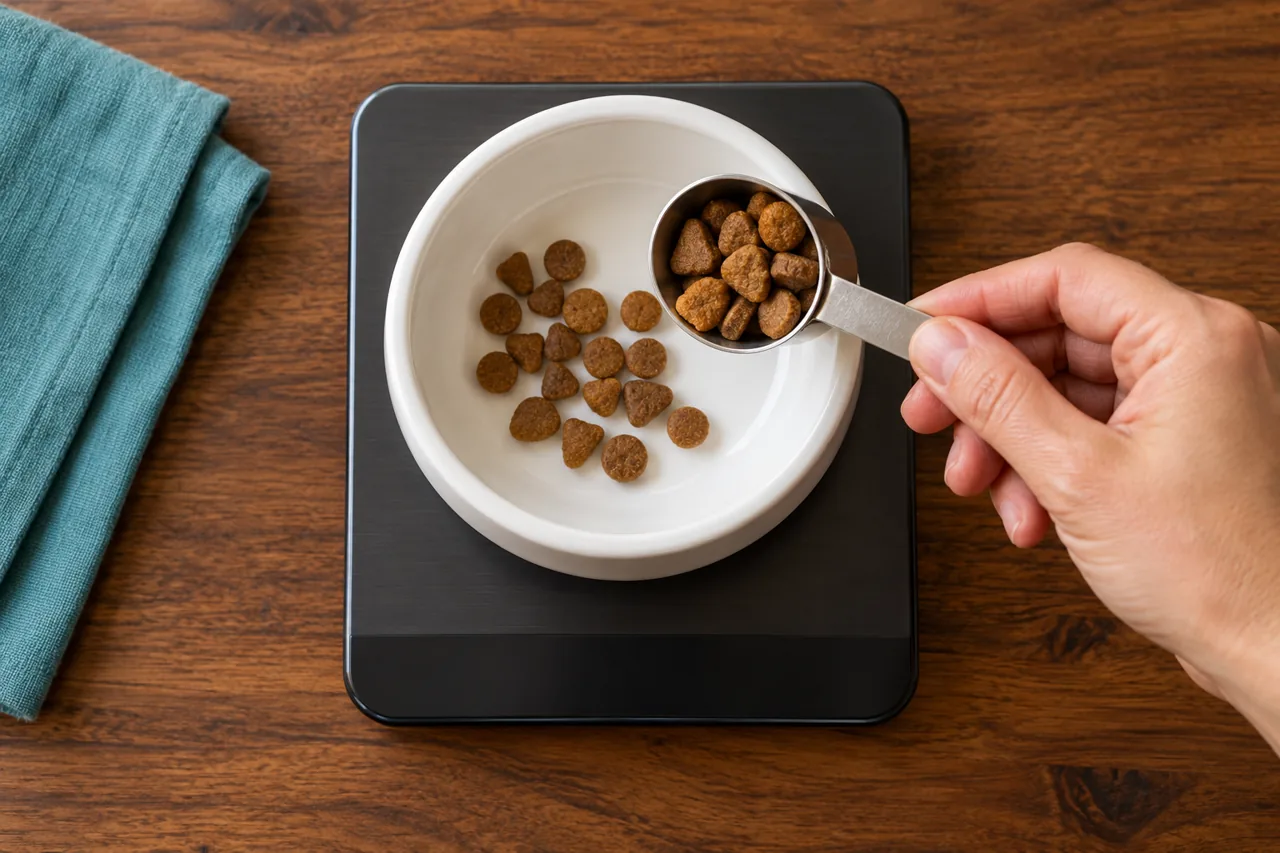
A kitchen scale helps measure a small portion consistently. If your dog is on a prescribed diet, ask before changing it with another food.
Current Package Prices and Cost per Calorie
The following one-time listed prices were checked on the manufacturer’s US website on October 30, 2026. All four sizes were shown as available at the check. Retailer prices, discounts, shipping, and later availability can differ.
Calculations use the advertised net weights, 453.59237 grams per pound, and the listed 4.5 kcal per gram. The resulting calorie totals are calculated estimates, not independent laboratory measurements.
| Package size | Listed price | Approximate calories in bag | Cost per 100 kcal |
|---|---|---|---|
| 16 oz / 1 lb | $29.98 | 2,041 kcal | $1.47 |
| 2.2 lb | $59.98 | 4,491 kcal | $1.34 |
| 5.5 lb | $143.48 | 11,226 kcal | $1.28 |
| 8.8 lb | $199.98 | 17,962 kcal | $1.11 |
The 8.8-pound package has a lower cost per calorie than the 2.2-pound package at these prices. It also requires a larger upfront purchase. Consider how quickly your household will use an opened bag and the manufacturer’s storage guidance before assuming the largest size is the best purchase.
Daily Spending Examples
| Hypothetical daily allocation | Approximate food weight | Daily cost, 2.2 lb bag | Daily cost, 8.8 lb bag |
|---|---|---|---|
| 100 kcal | 22.2 g | $1.34 | $1.11 |
| 300 kcal | 66.7 g | $4.01 | $3.34 |
| 500 kcal | 111.1 g | $6.68 | $5.57 |
| 900 kcal | 200.0 g | $12.02 | $10.02 |
| 1,200 kcal | 266.7 g | $16.03 | $13.36 |
These calorie allocations are spending scenarios, not recommendations for dogs of particular weights. Tax, shipping, discounts, wastage, and other foods are excluded.
For the 1,200-calorie example, an 8.8-pound bag would last approximately 15 days. The unrounded calculation gives about $400.80 over 30 days. Buying the 2.2-pound size at the checked price gives approximately $480.85 over 30 days for the same calorie allocation.
This does not establish a typical cost for every 50-pound dog. Nor does it establish a price advantage over a generic "premium kibble" or "mid-tier freeze-dried" category; that requires named foods, current prices, and equal calorie allowances.
How It Compares With ZIWI Lamb and Beef
The main differences are animal ingredients, the published nutrient guarantees, calorie density, and the precise adequacy statement. The following figures come from the current official US recipe pages, checked October 30, 2026.
| Published figure or label detail | Mackerel & Lamb | Lamb | Beef |
|---|---|---|---|
| Protein minimum | 44% | 38% | 38% |
| Fat minimum | 24% | 30% | 30% |
| kcal/kg | 4,500 | 4,950 | 4,900 |
| kcal per level cup | 427 | 469 | 465 |
| Taurine minimum | 0.26% | 0.15% | 0.05% |
| Chondroitin sulfate minimum | 1,300 mg/kg | 3,000 mg/kg | 1,300 mg/kg |
| Large-size growth in adequacy statement | Included | Included | Excluded |
Large-size growth refers here to dogs expected to weigh at least 70 pounds as adults. The Beef exclusion does not mean it is excluded for every adult large-breed dog.
Mackerel & Lamb has a higher protein minimum, lower fat minimum, and fewer listed calories per gram than the other two. Those differences do not establish a universal winner or predict an individual dog’s tolerance, weight response, or health outcome.
At an equal price per unit of weight, a lower-energy food costs more, not less, per calorie. The three checked 2.2-pound packages each cost $59.98, giving approximately $1.34 per 100 kcal for Mackerel & Lamb, $1.21 for Lamb, and $1.23 for Beef. Recalculate using the actual bag sizes and purchase prices when comparing.
Lamb and Beef also contain green mussel, so their names should not be mistaken for single-animal-species formulations. For more detail, see our ZIWI Lamb review, ZIWI Beef review, and three-recipe buying guide.
Preparation, Transition, and Storage
The air-dried recipe is ready to serve from the bag and does not require rehydration. ZIWI advises a gradual transition over at least seven days, increasing the new food while reducing the old food. Its transition guide provides further instructions.
Do not increase a serving simply because it looks smaller than another food’s portion. If significant or persistent digestive symptoms occur, seek veterinary guidance rather than assuming the cause is merely overfeeding or a normal transition.
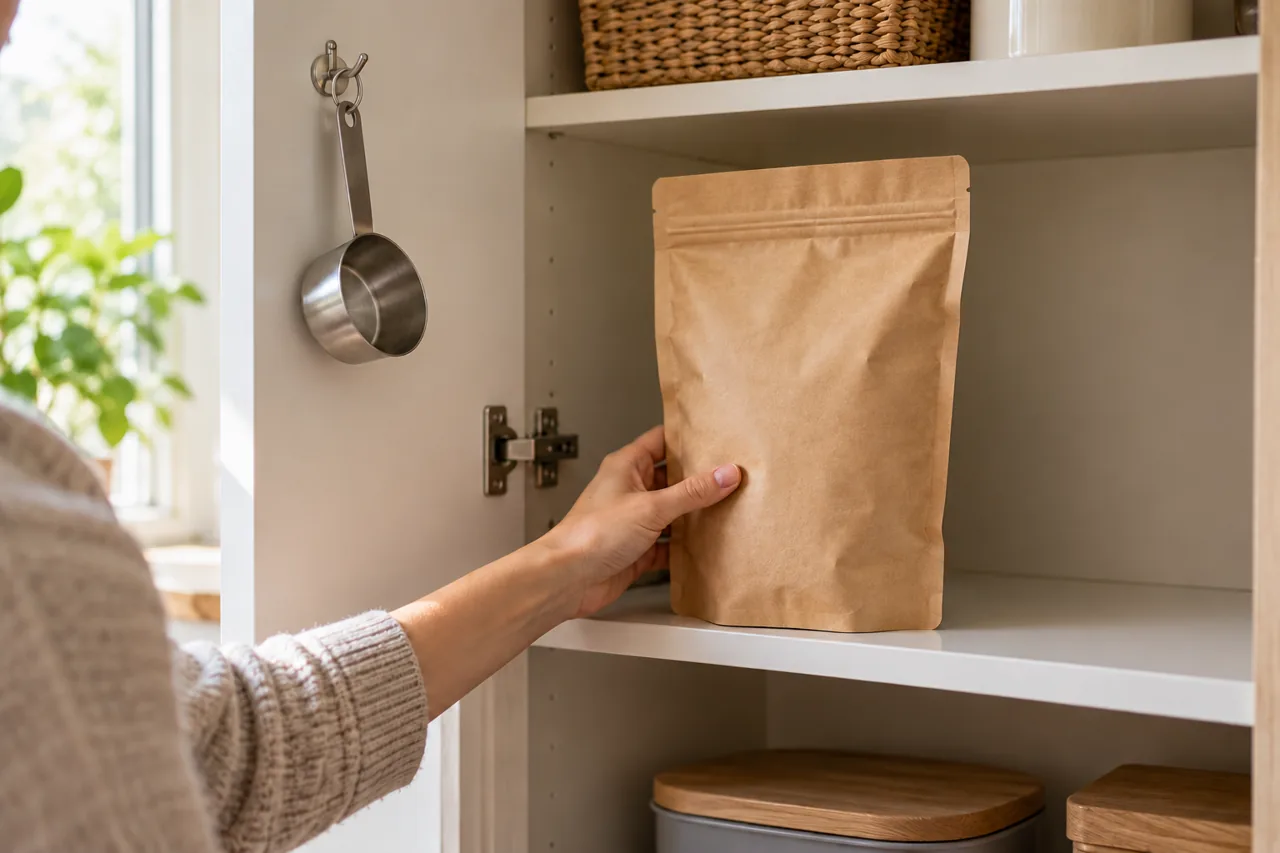
Keep the food in its sealed original pouch in a cool, dry location. ZIWI recommends using it before the printed best-before date and generally within eight weeks of opening. Exposure to air or moisture can damage the food; discard spoiled food, including food showing mold.
If using a protective outer container, keep the original bag inside it. Use clean, dry measuring equipment and keep water out of the bag. If water is added to an individual portion, follow the manufacturer’s guidance for that moistened food rather than applying the dry food’s storage rules to it.
The FDA’s pet food handling guidance also recommends cleaning bowls and feeding utensils and washing hands when handling pet food. Shelf-stable food still needs appropriate handling.
Pros and Cons
Potential Advantages
- Ready to serve without thawing or mixing with water.
- Current adequacy statement includes all life stages and large-size growth.
- Can be used as a complete food or a measured topper when appropriate.
- Compact servings and a shelf-stable format may suit some feeding and travel routines.
- Fish-and-lamb ingredients offer a different recipe choice from the Lamb- and Beef-focused options.
Limitations
- Full-meal spending can be substantial at larger calorie allocations.
- The best cost per calorie among the checked sizes requires a larger upfront purchase.
- Concentrated calories make portion measurement important.
- Contains fish, lamb, and mussel; allergy suitability cannot be inferred from the name.
- A lower fat minimum than the other two ZIWI recipes does not establish medical-diet suitability.
- Taste, aroma, and individual tolerance were not assessed in this review.
- Ingredient names and nutrient guarantees do not establish clinical benefits.
Frequently Asked Questions
Does It Contain More Than Mackerel and Lamb?
Yes. The formula includes green mussel, lamb organs and other tissues, plant ingredients, and supplemental nutrients. Lamb organs are not separate animal species, but the fish, lamb, and mussel make this a multiple-animal-source recipe.
Can It Be Fed as the Only Food?
The current adequacy statement supports complete-food use for the stated life stages. Confirm the label on the package and your dog’s individual needs, including any prescribed feeding plan.
Is It Suitable for Large-Breed Puppies?
The current US Mackerel & Lamb statement includes large-size growth. That differs from the Beef statement. Verify the package you buy and discuss your puppy’s portions and growth with your veterinarian.
Is It Cheaper to Use as a Topper?
Allocating fewer calories to it lowers the amount of ZIWI purchased, but the rest of the diet still costs money. It does not prove that a topper improves a suitable base diet or justify one percentage for every dog.
Will It Improve Skin, Coat, Joints, or Digestion?
No such outcome is established by this review. For a diagnosed problem or persistent symptoms, use veterinary guidance rather than assuming a food’s ingredients will treat the condition.
Final Verdict
ZIWI Peak Mackerel & Lamb offers a ready-to-serve fish-and-lamb formula with a current adequacy statement that includes large-size growth. The meaningful trade-offs are its cost, multiple animal sources, and the need to measure a concentrated food accurately.
Compare the exact label, your dog’s feeding plan, and the cost of the amount you would actually use. It can be considered as a complete meal or a measured topper, but the available evidence does not make either use the best choice for every household.